
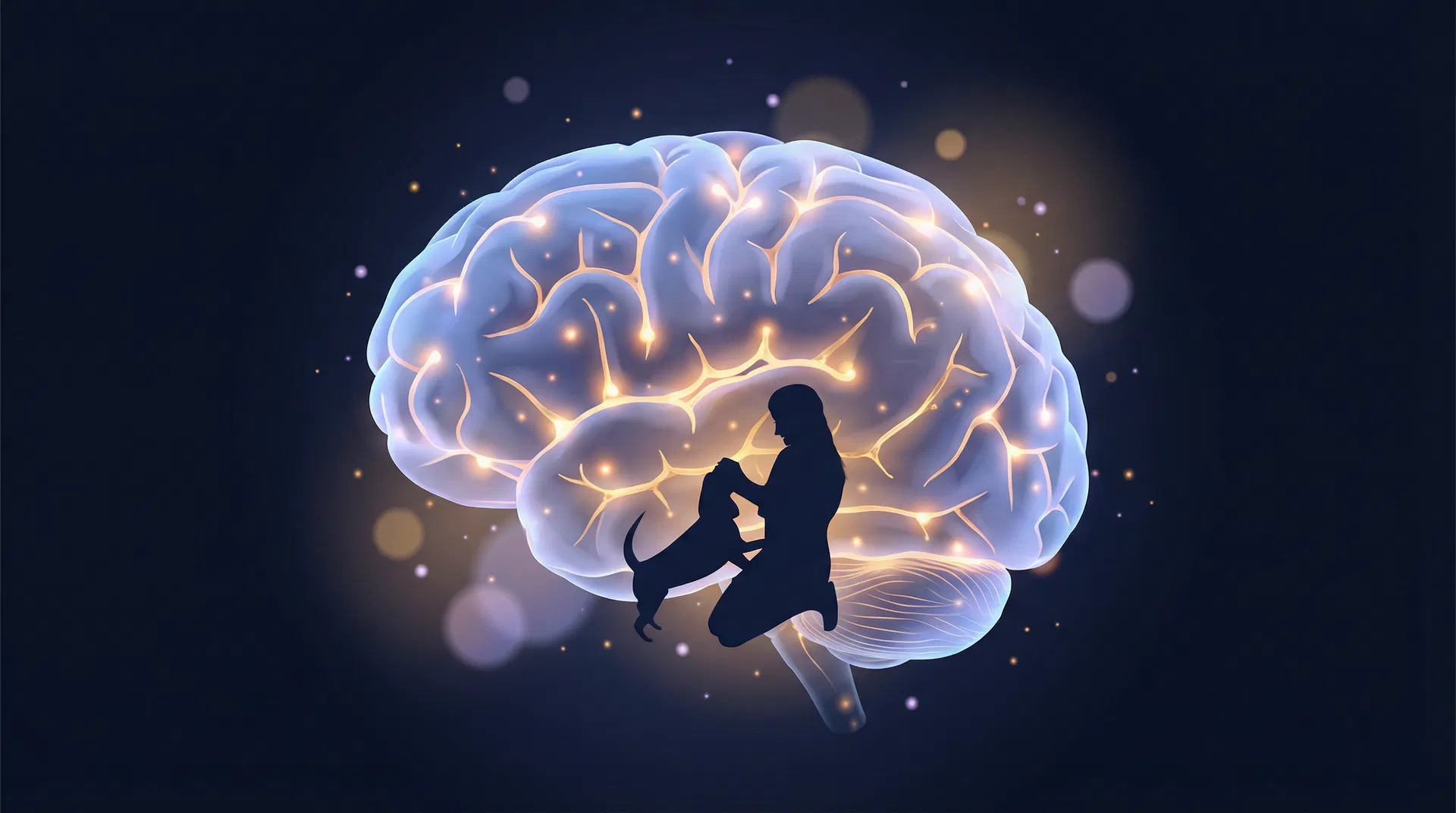
The Neuroscience of Reactivity: What's Actually Happening in Your Dog's Brain
Reactivity isn't a training problem — it's a brain problem. Here's what's actually happening in your dog's brain when they bark and lunge, and why understanding the neuroscience is the key to real change.
I know "neuroscience" sounds a bit heavy for a blog about dogs. But stick with me, because understanding what's actually happening inside your dog's brain when they react is genuinely life-changing. It shifts you from "Why won't my dog just behave?" to "Oh — their brain literally can't do that right now." And that shift changes everything.
Two Brain Systems, One Big Problem
Your dog's brain has two key systems that are relevant here. Think of them as the emotional brain and the thinking brain.
The emotional brain (centred around the amygdala) is fast, automatic, and survival-focused. It's the part that says "DANGER!" before your dog has even had time to process what they're looking at. It triggers the stress response — the cortisol, the adrenaline, the fight-flight-freeze reaction.
The thinking brain (the prefrontal cortex) is slower, more deliberate, and responsible for decision-making, impulse control, and learning. It's the part that would say, "Actually, that dog across the road isn't a threat. We can just walk past."
Here's the problem: when the emotional brain is activated, it essentially shuts down the thinking brain. This is called amygdala hijack, and it happens in humans too — it's why you can't think clearly when you're really angry or scared. The survival system takes priority over everything else.
So when your dog sees a trigger and goes into full reactive mode — barking, lunging, spinning — they are not choosing to ignore your commands. Their thinking brain is literally offline. They cannot hear you. They cannot process "sit" or "leave it" or "look at me." The emotional brain has taken over, and until it calms down, nothing else gets through.
This is why a single training session or a weekend workshop rarely produces lasting change. You can't override neuroscience with willpower — not yours, and not your dog's. The brain needs time, the right conditions, and a structured approach that works with its biology rather than against it.
Cortisol: The Stress Hormone That Sticks Around
When your dog reacts, their body floods with cortisol — the primary stress hormone. Cortisol is designed to help the body respond to immediate danger. It increases heart rate, sharpens focus, and prepares muscles for action. That's useful if you're actually being chased by a predator.
But here's the thing about cortisol: it doesn't just disappear when the trigger is gone. It takes time to clear from the body — sometimes 48 to 72 hours. That means if your dog has a reactive episode on Monday morning, their cortisol levels might not return to baseline until Wednesday or Thursday.
Now think about what happens if your dog has reactive episodes every day. Or multiple times a day. The cortisol never fully clears. It just keeps stacking. This is called chronic stress, and it fundamentally changes how the brain works:
- The amygdala gets bigger and more sensitive (more reactive to smaller triggers)
- The prefrontal cortex actually shrinks (less ability to think, learn, and regulate)
- The threshold for reaction gets lower and lower
This is why your dog might seem to be getting worse over time, even though you're trying everything. It's not that your training isn't working — it's that the neurochemistry is working against you.
Neuroplasticity: The Brain Can Change
Now for the good news. The brain is not fixed. It's plastic — meaning it can form new neural pathways and change its structure based on experience. This is called neuroplasticity, and it's the reason recovery is possible.
Every time your dog has a positive experience — a calm walk, a moment of connection with you, a successful encounter with a trigger at a manageable distance — new neural pathways are being formed. The thinking brain gets a little stronger. The emotional brain's grip loosens a little.
But here's the catch: neuroplasticity works both ways. Every time your dog goes over threshold and has a full reactive episode, those old survival pathways get reinforced too. The brain gets better at what it practises. So if your dog is practising panic every day, the panic pathways get stronger.
This is why management matters so much in the early stages. It's not about avoiding the world forever — it's about protecting your dog's brain while you're building new pathways. Every reaction-free day is a day the brain can heal.
The Polyvagal Theory Connection
There's one more piece of neuroscience that's worth understanding: polyvagal theory. Without getting too technical, this theory explains how the vagus nerve — the longest nerve in the body — regulates your dog's stress response.
The vagus nerve has two branches:
- The ventral vagal branch is associated with safety, social connection, and calm. When this is active, your dog can engage with the world, learn, and connect with you.
- The dorsal vagal branch is associated with shutdown, freeze, and collapse. When this is active, your dog might appear calm but is actually shut down — not processing, not learning, just surviving.
Many reactive dogs flip between these states rapidly. They might be in dorsal vagal shutdown (appearing "fine") and then suddenly flip into sympathetic activation (full reactive mode) with no warning. This is why it can feel so unpredictable.
The goal of nervous system work is to help your dog spend more time in the ventral vagal state — genuinely safe, genuinely calm, genuinely able to engage with the world. Not shut down. Not hypervigilant. Actually regulated.
What This Means for You and Your Dog
Understanding the neuroscience doesn't mean you need a degree in biology. It means:
- Stop blaming yourself or your dog. Reactivity is a brain-based response, not a character flaw.
- Stop expecting instant results. Neural pathways take time to change. Weeks, months, sometimes longer. But they do change.
- Prioritise reducing cortisol. Fewer triggers, more rest, more decompression. This is not "giving up" — it's giving the brain space to heal.
- Focus on safety, not obedience. A dog who feels safe will naturally become more responsive. A dog who's forced to comply while still terrified will only get worse.
- Work with your dog's biology, not against it. The REGAIN Method is built on these principles — every stage is designed to support the brain's natural capacity to heal and adapt.
If you've read this far, you clearly care deeply about your dog. That matters more than you know. Your dog doesn't need a perfect owner — they need one who's willing to understand what's really going on and meet them where they are.
Ready to Work With Your Dog's Brain Instead of Against It?
If you've been trying to train the reactivity out of your dog and it's not working, now you know why. You're not failing — you've just been given the wrong tools for the job.
The REGAIN Method is built on everything you've just read. Every stage works with your dog's neuroscience, not against it. We reduce cortisol, protect the brain while it heals, and build new neural pathways through carefully structured, real-world practice. It's not quick, but it's real — and it lasts.
One of my clients told me recently: "I finally understand why nothing worked before. We were treating the symptom. Now we're treating the cause." That's exactly it.
Your next step is simple: Book a free 20-minute chat. Tell me what's happening with your dog, and I'll help you understand what's going on in their brain and what we can do about it. No jargon, no pressure — just clarity.
---
References
1. LeDoux, J.E. (1994). "The amygdala: contributions to fear and stress." Seminars in Neuroscience, 6(4), 231-237. doi.org/10.1006/smns.1994.1030
2. Rosen, J.B. & Donley, M.P. (2006). "Animal studies of amygdala function in fear and uncertainty: Relevance to human research." Biological Psychology, 73(1), 49-60. doi.org/10.1016/j.biopsycho.2006.01.007
3. Cook, C.J. (2004). "Stress induces CRF release in the paraventricular nucleus, and both CRF and GABA release in the amygdala." Physiology & Behavior, 82(4), 751-762. doi.org/10.1016/j.physbeh.2004.06.013
4. Puurunen, J. et al. (2023). "Network analysis reveals abnormal functional brain circuitry in anxious dogs." PLoS ONE, 18(3), e0282087. doi.org/10.1371/journal.pone.0282087
5. Chmelíková, E., Bolechová, P. & Chaloupková, H. (2020). "Salivary cortisol as a marker of acute stress in dogs: a review." Domestic Animal Endocrinology, 72, 106440. doi.org/10.1016/j.domaniend.2019.106440
6. Guelfi, G. et al. (2019). "A cross-talk between blood-cell neuroplasticity-related genes and environmental enrichment in working dogs." Scientific Reports, 9, 6910. doi.org/10.1038/s41598-019-43402-4
Helpful Links
Jess Jones
Behaviour & Emotion Regulation Specialist · South Tyneside & County Durham
More Articles
Why Does My Dog Lunge at Other Dogs?
Your dog isn't being naughty when they lunge. They're overwhelmed, and their nervous system is doing the only thing it knows how to do. Understanding why is the first step to changing it.
What Does a Dysregulated Nervous System Look Like in Dogs?
A dysregulated nervous system doesn't always look like barking and lunging. Sometimes it looks like a dog who can't settle, who's always scanning, who goes from zero to a hundred in a heartbeat.
Ready to Talk About Your Dog?
Book a free 20-minute chat. No commitment, no pressure — just an honest conversation about your dog.
Book a Free Chat